For the first time, ISOC Norway took part in Arendalsuka – Norway’s annual week of political debate, networking and influence. Think of it as Norway’s own South by Southwest: if you like it, it is a vibrant festival of ideas and democracy; if you don’t, it is an elite party where everyone talks to people who already agree with them.
It takes place in Arendal (hence Arendalsuka) and lasts, ratherpredictable, a week («uka»).
So, what actually is Arendalsuka?
Imagine a relatively sleepy Norwegian coastal town of around 47,000 people suddenly being invaded by more than 2,000 events. During one week, the city centre becomes a giant conference venue. There are debates about everything from increasing salmon production to developing new ways of valuing volunteer work. Cars disappear from the streets and are replaced by promotion tents belonging to companies, NGOs, political parties, interest groups and anyone else with something to communicate.
And right there, between an organization representing Roma people in Norway and a new educational initiative, stood ISOC Norway – together with EFN Norway, the entire week. Directly opposite us was a double tent belonging to Norway’s association of American car enthusiasts.
That should give you some idea of the diversity.
And diversity is really what makes Arendalsuka interesting. Yes, the festival has its critics. It has been described as an echo chamber for the political and professional elite; a place where everyone talks and nobody listens; or simply an excuse to spend a week drinking with people from your own industry.
There is probably some truth in all of those descriptions.
But the sheer variety of people, organizations and conversations makes it much more interesting than that.
A good combination
Having a stand together with EFN turned out to be a particularly good idea.
EFN has a tradition of putting up simple polls and asking people to vote by dropping balls into different containers — agree or disagree. The vote is really just the starting point. What matters is the conversation that follows.
And some of the questions generated surprisingly lively discussions:
- Should Meta glasses be banned?
- Should there be a 16-year age limit for social media?
- Should we accept more surveillance if it gives the police better tools?
- etc
These are all questions on which both EFN and ISOC have clear positions. But at the stand, the reasoning behind those positions often turned out to be much more interesting than the positions themselves.
People disagreed. They changed their minds. They discovered that the person standing next to them had a completely different understanding of the problem.
And, perhaps most importantly, we got to talk to people we would normally never meet.
Not the usual crowd
Some of us have staffed ISOC stands at conferences and events before. Arendalsuka was different.
Not only because standing at a booth for an entire week is a very different exercise from doing a few hours at a conference. The people who stopped by were different, too.
They were not the usual digital-rights crowd hanging around the usual places people from ISOC and EFN tend to show up.
There were loud and boisterous children. Frail elderly people. Men who looked like they spent more time with their cars than with other people. Women who were out to save the world and had seemingly never considered that there might be such a thing as “the Internet” to save it through.
In other words: people.
And people who represented both the opinions we agree with and the opinions we don’t.
One of my favourite conversations was between a mother and daughter discussing age limits on social media. The daughter supported a 16-year age limit. The mother opposed it, stating that it was a slippery slope.
Eventually, we discovered that the daughter’s reasoning was essentially: It wouldn’t affect me anyway. It’s easy to get around. But it would probably make the Internet safer for younger kids.
That is a much more interesting observation than simplywatching people ticking “for” or “against” something.
It also illustrates why these conversations matter. The people affected by digital policy do not necessarily think about it in the same way that those of us working in digital rights do. We need to understand their train of thought in order to meet them with arguments that matter to them. We need to listen and learn if we want them to listen and learn.
The Internet is everywhere. Digital rights aren’t.
One of the things that struck us during the week was how much of Arendalsuka was actually about technology, but how little of the digital-rights community was there.
AI was everywhere. Discussions about using it, regulating it, hosting it, criticizing it, surviving it, loving it and hating it were almost impossible to avoid.
But the organizations representing digital rights, digital freedom and the underlying infrastructure of the Internet were scarce.
That creates a strange disconnect.
Digital technology is deeply embedded in almost every political issue being discussed. Yet the organizations whose core purpose is to defend an open, free and accessible Internet are not necessarily part of those conversations.
ISOC and EFN were, in some ways, standing in for a much larger community that simply wasn’t very visible.
So, was it worth it?
A week is a long time.
The organization of the stand could certainly have been better. We learned a lot about what it takes to maintain a presence for seven days, and what we would do differently next time.
But the most important lessons were not about logistics.
They were about representation.
- First: Digital rights are not particularly well represented in the broader political conversation in Norway. There were plenty of discussions about technology, AI, surveillance and digitalization, but relatively few organizations explicitly representing the rights and freedoms of the people using those technologies.
- Second: The audience at Arendalsuka was considerably more diverse than the people who normally associate with ISOC and EFN. This is an absolute opportunity. Digital rights are ultimately about society, democracy and people’s everyday lives, we need to be interacting with more than the people who already know what ISOC stands for.
- And third: ISOC Norway is not yet perceived as a natural participant in Norway’s political and semi-political ecosystem. We were there, but we were not part of the program. We did not participate in panels, and we were not automatically among the organizations people thought of when discussing digital policy.
That may be the most important takeaway of all.
If the Internet is now part of almost every political conversation, ISOC Norway needs to become part of those conversations too.
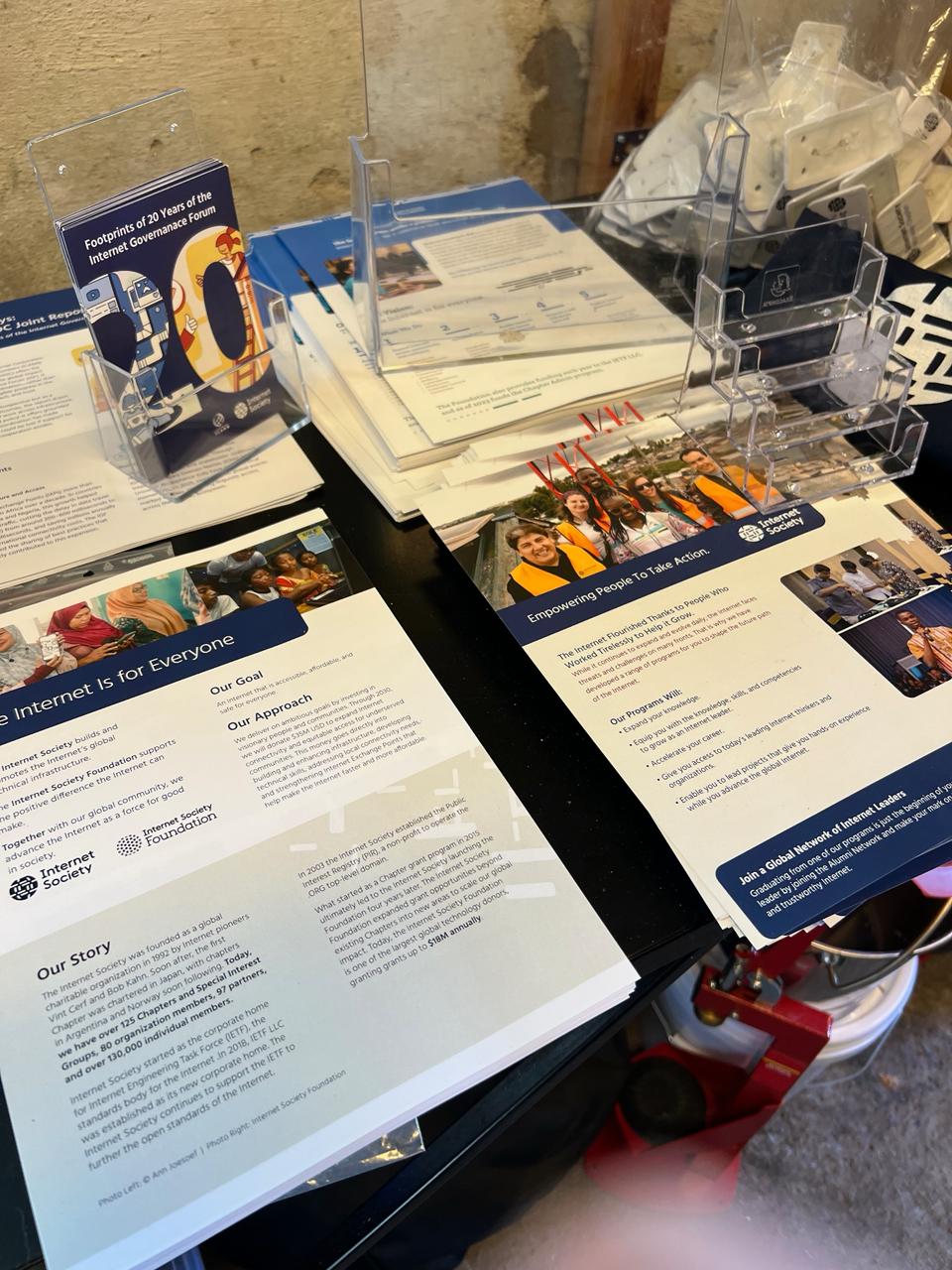
A nice collection of flyers were distributed